When you think of precious metals, gold, silver, and platinum probably come to mind. But there’s another valuable metal that often flies under the radar: palladium. With its naturally silvery-white appearance and unique chemical properties, palladium plays an important role in everything from fine jewelry to automotive manufacturing. Although it may be less familiar than other precious metals, palladium has its own distinct market and a wide range of applications.
So, what exactly is palladium, what makes it valuable, and how can you tell if you own something containing it?
What Is Palladium?
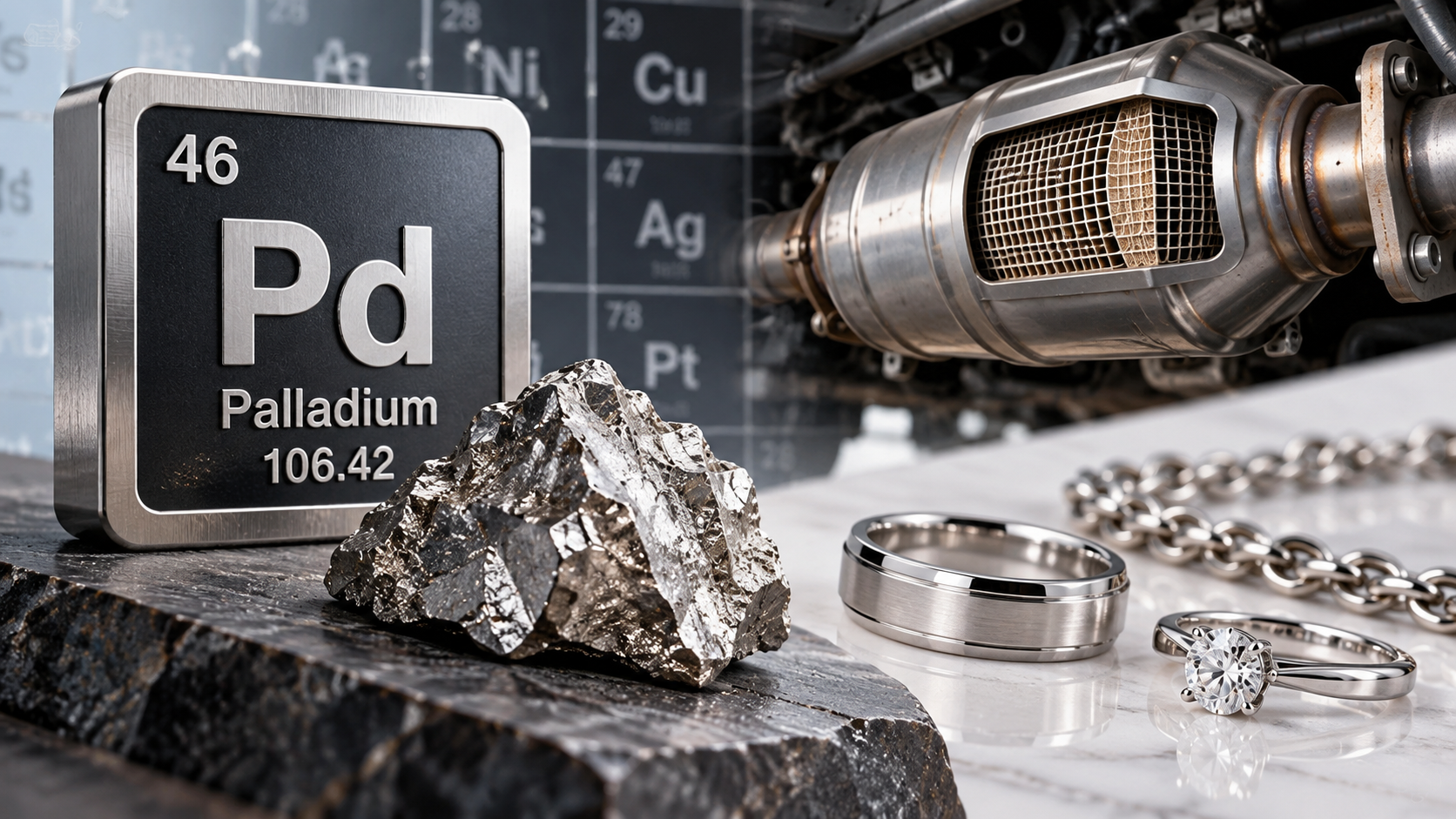
Palladium is a naturally occurring precious metal with the chemical symbol Pd and atomic number 46. It belongs to the platinum-group metals (PGMs), a family of six metals that includes platinum, rhodium, ruthenium, iridium, and osmium. Discovered in 1803 by English chemist William Hyde Wollaston, palladium was named after the asteroid Pallas. The metal has a naturally silvery-white appearance, resists corrosion, and is considerably less dense than platinum.¹
While palladium shares several characteristics with platinum, it is a distinct element with its own properties, applications, and market value. One of its most important characteristics is its ability to act as a catalyst, helping chemical reactions occur without being consumed in the process. This property makes palladium particularly valuable in industrial manufacturing.¹
What Is Palladium Used For?
Unlike gold, which is widely recognized for its use in jewelry and investment products, palladium has a particularly strong connection to industrial demand. Its unique physical and chemical properties make it useful across several industries, including automotive manufacturing, fine jewelry, electronics, and chemical processing.
Automotive Catalytic Converters
One of palladium’s most prominent applications is in catalytic converters, particularly those found in gasoline-powered vehicles. Catalytic converters help reduce harmful exhaust emissions by enabling chemical reactions that convert pollutants such as carbon monoxide, hydrocarbons, and nitrogen oxides into less harmful substances. Palladium plays an important role in these reactions, making it a valuable component of automotive emissions-control technology.¹
Because of its extensive use in catalytic converters, the automotive industry represents a major source of palladium demand. Changes in vehicle production, emissions regulations, and the transition toward electric vehicles can influence how much palladium is needed worldwide.²
Fine Jewelry
Palladium is also used in fine jewelry, particularly wedding bands and rings. Its naturally white appearance makes it an alternative to platinum and white gold, while its lower density means that a palladium ring of equivalent size and design will generally feel lighter than one made from platinum. Palladium is also resistant to corrosion, making it appropriate for jewelry intended for everyday wear.³
In addition to being used as the primary precious metal in jewelry, palladium can be incorporated into white gold alloys. When combined with gold and other metals, it helps produce a lighter-colored alloy. Unlike rhodium-plated white gold, palladium jewelry does not require plating simply to achieve its natural white appearance.¹
Electronics and Other Industrial Applications
Beyond jewelry and automotive manufacturing, palladium is used in certain electronic components, including ceramic capacitors found in electronic devices. It also has applications in chemical manufacturing, hydrogen purification, and dental alloys. These different uses demonstrate why palladium is valued not only for its appearance and rarity, but also for its ability to perform important functions across several industries.¹
Why Is Palladium Valuable?
Palladium’s value comes from a combination of limited natural supply, industrial demand, and its useful physical and chemical properties. Like other precious metals, palladium must be extracted and refined before it can be used commercially. Much of the world’s palladium production is concentrated in a relatively small number of countries, particularly Russia and South Africa, making global supply sensitive to mining conditions, production changes, and geopolitical developments.²
Palladium is also frequently recovered as a byproduct of mining other metals, including nickel and copper. As a result, its availability is influenced not only by demand for palladium itself, but also by the economics of mining these associated metals. Recycling, particularly from used automotive catalytic converters, provides another source of palladium supply.¹ ²
Industrial demand is an equally important factor in determining its value. Because palladium is widely used in gasoline-powered vehicle catalytic converters, changes in automotive production and the adoption of electric vehicles can affect its market. Its price fluctuates independently of gold, silver, and platinum, reflecting its own supply-and-demand conditions.
Although palladium is a relatively rare precious metal, rarity alone does not determine its price. Industrial applications, available supply, recycling activity, and wider economic conditions all contribute to its market value.
Palladium vs. Platinum: What’s the Difference?
Palladium and platinum are closely related precious metals with similar appearances, but they are not interchangeable. Both belong to the platinum group and have a naturally silvery-white color, making them attractive options for fine jewelry. However, they differ in density, physical characteristics, and industrial applications.
One of the most noticeable differences is weight. Palladium has a density of approximately 12.0 grams per cubic centimeter, compared with approximately 21.5 grams per cubic centimeter for platinum. As a result, palladium jewelry can be considerably lighter than an equivalent piece made from platinum. This difference can be particularly noticeable in larger rings and other substantial jewelry pieces.¹
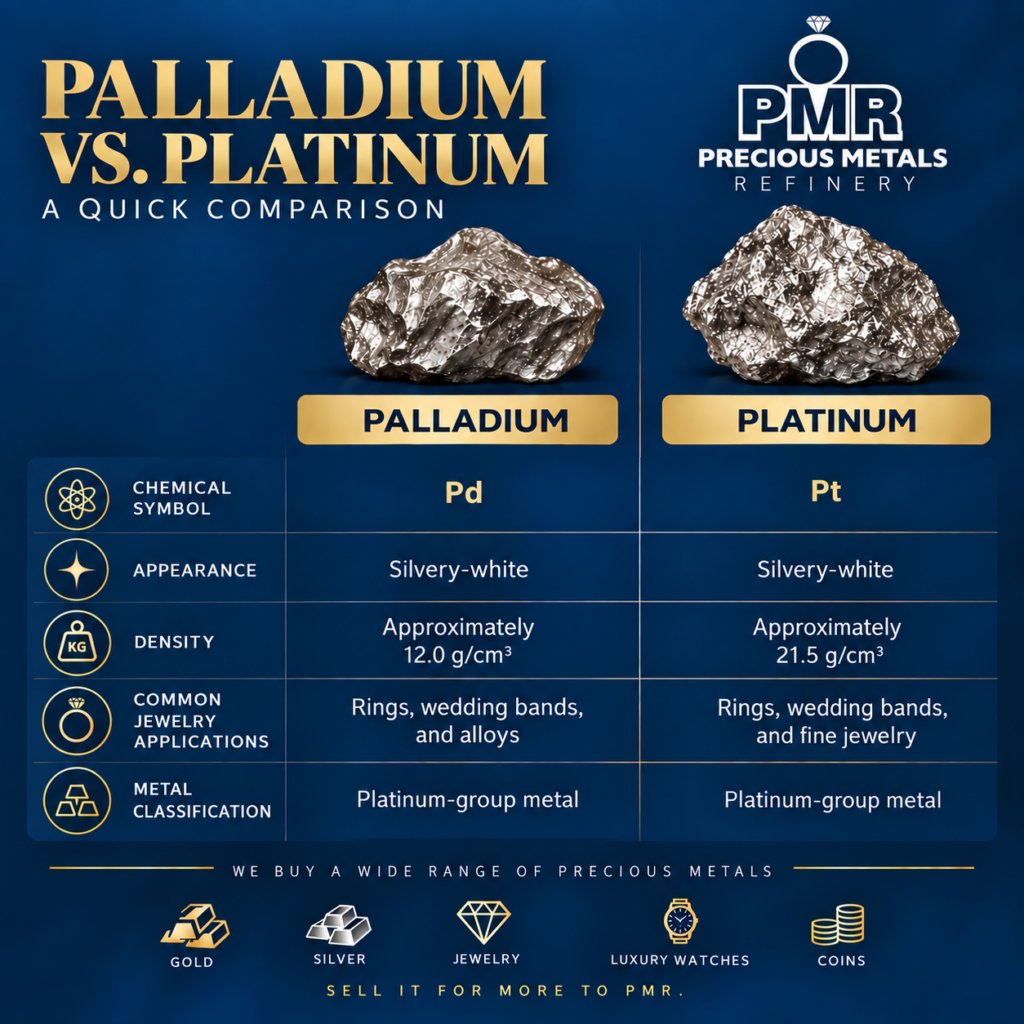
Both metals have value beyond their decorative appearance, particularly in industrial applications. Neither is consistently more valuable than the other, as their market prices fluctuate independently based on supply and demand.
How Can You Identify Palladium Jewelry?
If you own a white-colored ring or another piece of jewelry, you may wonder whether it contains palladium. One place to start is by examining the item’s hallmarks, which are markings that may indicate the metal’s composition and purity. Like gold and platinum, palladium jewelry can feature markings that identify its precious-metal content, often expressed in parts per thousand.³
Common palladium markings include:
| Pd950 | 95% palladium |
| Pd500 | 50% palladium |
| Pd | Chemical symbol for palladium |
For example, an item marked Pd950 indicates an alloy containing 950 parts palladium per 1,000 parts, or 95% palladium. Similarly, Pd500 indicates an alloy containing 50% palladium. These markings can help identify the metal, although the presence of a hallmark alone does not guarantee an item’s authenticity or exact composition.
Jewelry markings may be worn, missing, or inaccurate, particularly on older pieces. Professional testing can help determine whether an item contains palladium and establish its metal composition. It’s also important to understand that white gold containing palladium is not the same as jewelry made primarily from palladium. In white gold, palladium may be one of several metals combined with gold to create the finished alloy.¹ ⁴
Can You Buy Palladium as Bullion?
Yes. In addition to its industrial and jewelry applications, palladium is available in physical investment products, including bullion bars and coins. Like gold, silver, and platinum bullion, these products allow individuals to own physical precious metal rather than purchasing jewelry or other manufactured items.
One recognizable example is the American Palladium Eagle, introduced by the United States Mint in 2017. Each coin contains one troy ounce of .9995 fine palladium, representing 99.95% purity. Its obverse features the Winged Liberty design associated with the Mercury dime, while the reverse depicts an eagle perched on a rock.⁵
Palladium bullion derives much of its value from its precious-metal content and the prevailing market price. However, certain coins may also carry additional collectible value based on their condition, rarity, mintage, and collector demand. As with other precious-metal products, the purchase price and potential resale value may differ due to premiums, dealer margins, and market conditions.
Is Palladium Jewelry Worth Anything?
Yes. Jewelry containing palladium can have value based on its precious-metal content, although the amount depends on several factors, including the item’s weight, purity, current palladium market price, and any additional value associated with its design, gemstones, or manufacturer. For example, a ring made from 95% palladium contains a different amount of precious metal than a ring made from an alloy containing 50% palladium. Similarly, white gold containing palladium should be evaluated according to its complete metal composition rather than treated as pure palladium.
As with other precious metals, an item’s theoretical metal value is not necessarily the same as the amount a buyer will offer. Testing, processing, refining, and resale considerations can influence the final offer. This is why understanding an item’s composition is an important part of determining its value, particularly when dealing with unfamiliar jewelry or pieces that may have been inherited.
If you have palladium jewelry or other precious metals you’re considering selling, Precious Metals Refinery purchases palladium jewelry and offers professional evaluations to help you better understand what your items contain and what they may be worth. Our experienced buyers use professional testing equipment to assess your valuables and explain how your offer is determined, providing a transparent, straightforward selling experience without pressure or obligation.
Visit your nearest Precious Metals Refinery location for a free evaluation and find out what your precious metals are worth.
Sources
1. Royal Society of Chemistry. Palladium: Element Information, Properties and Uses.
https://periodic-table.rsc.org/element/46/palladium
2. U.S. Geological Survey. Mineral Commodity Summaries 2026: Platinum-Group Metals.
https://pubs.usgs.gov/periodicals/mcs2026/mcs2026.pdf
3. Rio Grande. Palladium: An Introduction.
https://products.riogrande.com/content/Instruction-Sheets/Palladium-An-Introduction-Ed-ll-IS.pdf
4. Federal Trade Commission. Buying Platinum, Gold, and Silver Jewelry.
https://consumer.ftc.gov/articles/buying-platinum-gold-and-silver-jewelry
5. United States Mint. United States Mint Launches New Palladium Bullion Coin Program. September 18, 2017
https://www.usmint.gov/news/press-releases/united-states-mint-launches-new-palladium-bullion-coin-program