
Counterfeiting precious metals is not a new problem. What has changed is the sophistication. Where crude fakes once failed a basic visual check, modern counterfeits can pass a scale, fool a magnet, survive a surface acid test, and in some cases even beat standard XRF testing. At PMR, our buyers encounter counterfeit gold, silver, and watches on a regular basis. Understanding how detection works is useful for anyone who buys, sells, or inherits precious metals.
There are three distinct categories of precious metals fraud, and they require different tests to catch. The first involves base metal disguised as precious metal. The second involves genuine precious metal with a fraudulent maker’s mark. The third involves sophisticated structural counterfeits where the deception is hidden inside the item rather than on its surface.
The Three Types of Precious Metals Fraud
Base Metal Disguised as Precious Metal
This is the most common category. A base metal such as copper, brass, or nickel is electroplated with a thin layer of real gold or silver. The surface passes a visual check and may even survive a shallow acid test if the plating is thick enough1. Gold-plated items are the most common form of this fraud PMR encounters. Many arrive with no ill intent from the seller who inherited or purchased them believing they were solid gold.
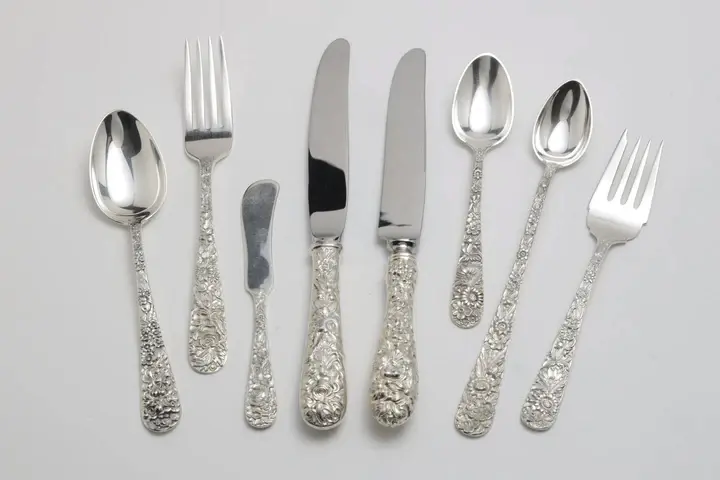
Silver fakes typically use lead, copper, or lead-tin alloy cores2. Silver-plated items often appear in flatware, coins, and jewelry. When tested against genuine sterling, the difference is immediately apparent under XRF, but visual inspection alone will not catch it.
Real Metal, Fraudulent Maker’s Mark
This category is different from fake metal fraud and is frequently misunderstood. The item contains genuine silver or gold and will pass every purity test. What is fabricated is the brand attribution. PMR regularly sees items bearing fake Tiffany and Co. marks, for example. The silver is real. The Tiffany stamp is not.
The goal in this type of fraud is to inflate the value above melt. A piece of sterling silver flatware is worth its melt value. A piece of Tiffany sterling flatware in excellent condition can be worth multiples of melt on the secondary market. Counterfeiters stamp fake maker’s marks to capture that premium. Catching this requires knowledge of how genuine marks look under magnification, what fonts and hallmark depths authentic pieces use, and cross-referencing provenance when possible.
Sophisticated Structural Counterfeits
The most dangerous category involves fakes where the deception is hidden inside the item. Tungsten-filled gold bars are the primary example. Tungsten has a density of 19.25 grams per cubic centimeter, nearly identical to gold’s density of 19.30 grams per cubic centimeter3. A bar drilled out, filled with a tungsten core, and resealed with a gold cap can pass a scale check and basic dimensions check with results close enough to fool an untrained buyer. These counterfeits are most commonly found in larger bars.
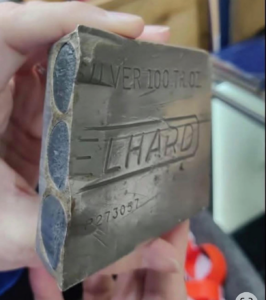
The higher profit margin on 10 ounce and one kilogram bars justifies the more complex manufacturing required4. PMR has encountered tungsten-filled bars brought in by sellers who had no idea the item was not genuine. In one documented case in Manhattan, a dealer paid $100,000 for four 10-ounce PAMP Suisse bars that contained tungsten cores1. The bars had already passed XRF surface testing and a scale check
Understanding how precious metals are processed after purchase helps explain why accurate testing matters at every step. Read our guide on how precious metals are refined to see the full chain from raw material to investment-grade bullion.
How PMR Tests Every Item
No single test catches every type of counterfeit. PMR uses a layered approach, starting with the fastest non-invasive checks and progressing to more definitive methods when needed. Here is how that process works.
The Magnet Test
Gold and silver are both non-magnetic metals5. A strong rare earth neodymium magnet applied to an item immediately reveals ferrous content. If a coin or bar sticks to a magnet, it contains iron or steel and is not genuine precious metal.
There are important limitations. Copper, brass, zinc, and lead are also non-magnetic, so passing the magnet test does not confirm an item is real5. More relevantly, tungsten is paramagnetic rather than ferromagnetic, meaning it can be weakly attracted to a magnet under certain conditions but does not behave like iron6. The magnet test is a fast first screen, not a conclusive result.
The Scratch and Acid Test
The acid test has been used by jewelers for centuries7. The item is rubbed firmly against a dark abrasive testing stone to leave a metallic streak. A drop of acid corresponding to a specific karat or metal is then applied to the streak on the stone rather than directly to the item. The chemical reaction reveals the metal content.
For gold, if the streak dissolves, the gold is of lower purity than the acid being tested. If it holds, the item meets at least that karat8. For silver, nitric acid is used and the color of the reaction indicates genuine silver versus a base metal substitute. One practical advantage of the touchstone method is that the acid is applied to the streak on the stone rather than to the item itself, reducing damage risk to the piece.
The acid test has real limitations. It reads the surface layer only. A thickly gold-plated base metal item can pass an acid test if the plating is deep enough9. It is also a subjective test that requires experienced interpretation. Two testers applying the same acid to the same streak can reach different conclusions. For this reason PMR uses acid testing as a supplementary method alongside XRF rather than as a standalone result.
Weight and Dimensions
Every legitimate coin and bar has published specifications for diameter, thickness, and weight. These specifications are publicly available from the issuing mint. A coin that is even fractions of a gram off or a fraction of a millimeter too thick or too wide indicates something may be wrong.
Thickness is a particularly useful tell for coins made with lower-density fill metals. Because copper has a density of approximately 8.96 grams per cubic centimeter compared to gold’s 19.32, a counterfeiter using copper as a fill cannot match gold’s weight without making the coin larger or thicker than the genuine version10. The coin may feel approximately right in the hand but a caliper measurement will reveal the discrepancy.
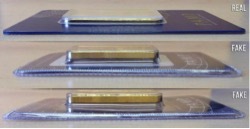
Sophisticated tungsten fakes can pass dimensional and weight checks because tungsten’s density is so close to gold’s. This is precisely why weight and dimensions alone are never sufficient for high-value items, and why XRF or ultrasonic testing becomes necessary3.
XRF Testing
X-ray fluorescence testing is the most reliable non-destructive method available for precious metals verification. An XRF analyzer fires a targeted beam of X-rays at the item, which causes the atoms in the metal to emit secondary energy signatures. The machine reads those signatures and provides a precise percentage breakdown of every element present in the alloy, typically within seconds11. A 14 karat gold ring, for example, will return a result showing approximately 58.5 percent gold, with the remaining percentage broken down by other metals present in the alloy.

XRF testing is non-destructive, fast, and far more precise than acid testing. It catches gold-plated items, identifies incorrect alloy compositions, confirms purity marks, and detects hazardous metals sometimes added to alloys such as lead or cadmium12. PMR uses XRF on every item evaluated. This is the same testing process used when you bring gold or silver in for evaluation. Learn more about selling gold or selling silver to understand how the evaluation works There is one significant limitation worth understanding. Standard XRF analyzers penetrate only approximately 10 to 15 microns below the surface, roughly one-tenth the width of a human hair1. A sophisticated tungsten-filled bar coated in a thick enough layer of real gold will return a surface reading of pure gold. The tungsten core is invisible to standard surface XRF. For high-value bars of unknown provenance, ultrasonic testing is the additional step that detects internal substitution by measuring how sound travels through the metal4.
What to Do If You Think You Have a Fake
If you purchased something that you now suspect is counterfeit, or if you inherited items and are uncertain of their authenticity, a few steps are worth following before you do anything else.
Do not attempt to sell a counterfeit you know to be fake. Knowingly selling counterfeit precious metals is fraud. If you discover you have been sold a fake, the appropriate step is to contact the seller and, if necessary, report it to local authorities.
Do not clean, polish, or attempt to test it yourself. Household acid tests can damage items and produce unreliable results without proper equipment and training.
Document where you got it and what you paid. If it turns out to be counterfeit and you purchased it recently, this information will matter when contacting the seller or reporting the fraud.
Bring it in for a professional evaluation. PMR will test any item and tell you exactly what it is at no charge. You are not obligated to sell.
Sources
1 GoldSilver.com, “How to Spot Fake Gold and Silver: Authentication, Tests, and Red Flags,” goldsilver.com/industry-news/article/how-to-spot-fake-gold-and-silver-authentication-tests-and-red-flags/
2 Bullion Trading LLC, “Spot Fake Gold & Silver in 2025,” bulliontradingllc.com/blog/how-to-spot-fake-gold-and-silver-complete-detection-guide-for-precious-metals-investors-in-2025/
3 VR XRF, “How to Spot Tungsten-Filled Gold Bars Without Cutting Them,” vrxrf.com/blog/how-to-spot-tungsten-filled-gold-bars-without-cutting/
4 VR XRF, “How to Spot Tungsten-Filled Gold Bars Without Cutting Them,” vrxrf.com/blog/how-to-spot-tungsten-filled-gold-bars-without-cutting/
5 SilverCoins.com, “Fake Silver Coins: 14 Ways to Spot Counterfeits,” silvercoins.com/fake-silver-coins-14-ways-to-spot-counterfeits/
6 Gold and Co., “Recognize Counterfeit Gold Bars and Fake Gold Coins,” goldundco.at/en/lexikon/goldbarren-faelschung-erkennen/
7 VR XRF, “How Do Gold Buyers Test Scrap Jewelry?,” vrxrf.com/resource/guide/how-do-gold-buyers-test-scrap-jewelry/
8 CanadaGold / Seattle Gold, “How We Test Your Gold,” seattlegold.com/testing-gold/
9 Evident Scientific, “Comparing Gold Testing Methods to Maximize Profits: XRF vs. Acid Scratch vs. Conductivity Testing,” ims.evidentscientific.com/en/insights/comparing-gold-testing-methods/
10 GoldSilver.com, “How to Spot Fake Gold and Silver,” goldsilver.com/industry-news/article/how-to-spot-fake-gold-and-silver-authentication-tests-and-red-flags/
11 Thermo Fisher Scientific, “Revolutionizing Gold Analysis: Why XRF Outshines Traditional Methods,” thermofisher.com/blog/metals/revolutionizing-gold-analysis-why-xrf-outshines-traditional-methods/
12 Evident Scientific, “Comparing Gold Testing Methods,” ims.evidentscientific.com/en/insights/comparing-gold-testing-methods/
13 US Coinage Act of 1965; verified via multiple numismatic sources